How does industrial air treatment work?
Industrial air purification involves a number of steps and techniques designed to eliminate or reduce pollutants in the air.
These processes include:
1. Filtration: Use of high-efficiency filters to capture dust and contaminants.
2. Adsorption: A process in which VOCs are trapped on the surface of materials such as activated carbon, which is particularly effective for a wide range of pollutants.
3. Condensation: Technique used to lower the temperature of the air stream loaded with moisture and VOCs, enabling them to pass from the gas phase to the liquid phase.
4. Absorption: VOCs are absorbed by specific liquids, enabling them to be separated from the air to be treated.
5. Thermal oxidation: Destroys VOCs at high temperatures (700-1000°C) by converting them into carbon dioxide and water, often used for high concentrations of pollutants. In this technique, beds of ceramic material can be used to store the heat of combustion. This heat is then used to preheat the exhaust gas stream, giving a heat recovery efficiency of 90-98% This is called regenerative thermal oxidation.
6. Catalytic oxidation: Operates at lower temperatures (200-450°C) using a catalyst, reducing energy requirements and limiting the formation of hazardous by-products such as nitrogen oxides.
7. Biological oxidation: Uses micro-organisms to degrade VOCs into CO2, water and biomass. Although highly effective, this method requires stable conditions for the micro-organisms, which may limit its industrial application.
8. Heat exchangers: Heat exchangers are commonly used to recover thermal energy from off-gases. Common types include plate heat exchangers, tubular heat exchangers, and recuperators, which transfer heat from exhaust gases to other process fluids, improving the overall energy efficiency of treatment systems.
What are the fields of application for air treatment?
Treating air is essential in many industrial sectors
1. Chemical industry: For control of solvent fumes and other hazardous chemicals.
2.Pharmaceutical: To maintain sterile environments and avoid cross-contamination.
3.Agri-food: To ensure food safety by eliminating odors and microbial contaminants.
4.Waste treatment: To control fumes from incinerators and other waste management facilities.
5. Surface treatment: Used in the aerospace, automotive and furniture industries for degreasing and painting, often using chlorinated, aliphatic or aromatic solvents.
6.Printing: For commercial and packaging printing, using solvents such as toluene, esters, ketones and alcohols.
7.Rubber and tire industry: For mixer extraction and gluing/vulcanizing, using chlorinated and aliphatic solvents.
Main features of air treatment solutions


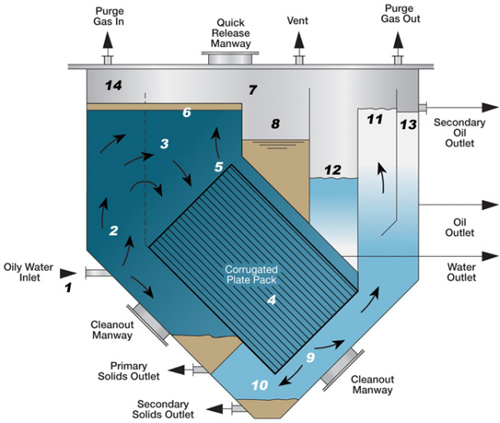
 cpi波纹板油水分离器